
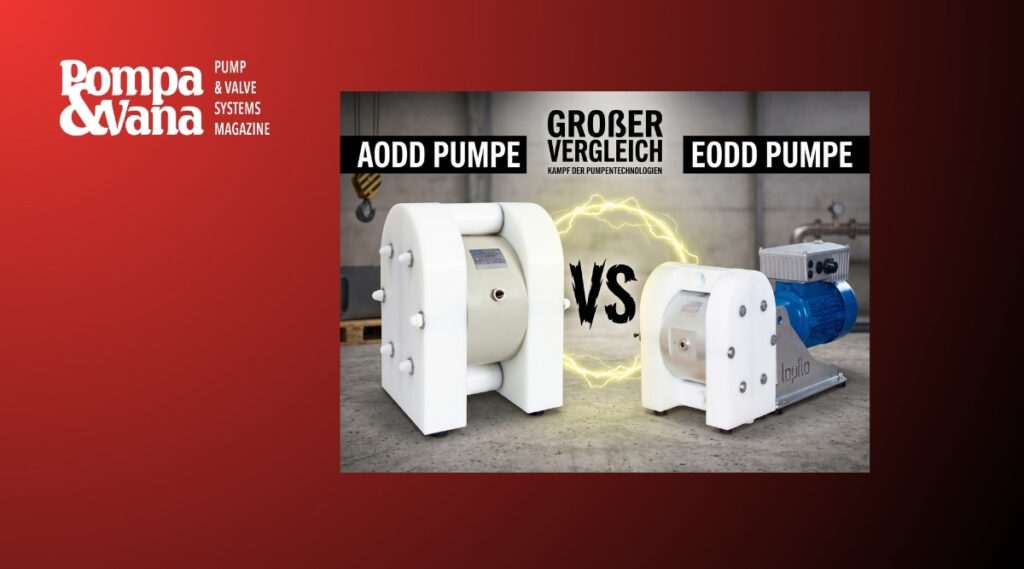
Compressed-air-driven AODD and electric-motor-driven EODD double diaphragm pumps use the same pumping principle. However, there are important differences in terms of energy consumption, pressure capability, controllability and explosion protection.
Same principle, different drive
In both pump types, two diaphragms move together via a piston rod. While one pump chamber draws in fluid, the other discharges fluid into the delivery line.
The fundamental difference is that the piston rod is moved by compressed air in AODD systems and by an electric motor in EODD systems.
AODD has the edge at high pressure
AODD pumps can stall without damage when the back pressure reaches the drive pressure and can restart when the pressure drops.
The source gives a maximum operating pressure of 8 bar for the Tapflo T series and a capacity of up to 820 l/min depending on the model. This design is an advantage in applications that require a safe stop against a closed valve.
EODD can lower energy consumption
In electric EODD pumps, flow is controlled by changing the motor speed with a frequency converter, and no compressed air is used.
The maximum operating pressure of the TE series is between 4 and 6 bar depending on the model. These pumps must not be operated against a closed discharge line and need to be protected with a pressure relief valve.
In Steinle’s example, the energy consumption of the T50 model via the compressor is calculated at around 1.5-2.0 kWh per hour, while the electricity consumption of the TE50 at full load remains below 1 kWh per hour. For this reason, an electric drive can offer advantages in energy costs over long operating periods.
EODD stands out in automation
While flow in AODD pumps is adjusted via air pressure and air volume, motor speed in EODD systems can be controlled more precisely via a frequency converter.
Integration of electric systems into PLC infrastructure also offers advantages in continuous and controlled processes.
Explosive atmosphere conditions affect the choice
The source states that TX series AODD pumps have options suitable for Zone 1 and the TZ series for Zone 0 applications.
The electric TXE series is offered for Zone 1, while there is no Zone 0 version.
Selection should be based on the application
AODD pumps come to the fore in applications requiring high pressure, high flow, mobile use or Zone 0.
EODD pumps, on the other hand, offer advantages in processes where long operating times, low energy consumption and precise flow control are important.
Pump selection should be made by evaluating operating time, pressure and flow requirements, energy infrastructure, level of automation and explosion protection requirements together.

Author
Pompa Vana


 Pump Valve and Systems MagazinePompa Vana · September-October 2026Read the latest issue free →